
Ukrainians Who Help Their Country From Afar: The Story of Edinburgh Spiders
By Anna Konovalenko
Ukrainians abroad, united in the efforts, are challenged to find new effective methods to help their country amidst war. The Ukrainian community in Scotland helps their country in different ways one of them is making camouflage nets for the frontline.
Leaving her husband and a son in Ukraine, Hanna, the coordinator of Edinburgh Spiders (the name of the camouflage nets’ group), came to Scotland in April 2022 and found a job at the International College of Napier University. Already in July 2022, Hanna and her daughter set the first location for the camouflage nets.

Hanna recalled that the idea was born out of her daughter’s fear of not making enough effort towards collective victory. Sophia, Hanna’s daughter, came up with the idea to start making the camouflage nets and started setting up the first location and looking for materials. Later, when she went to the translation job in a military camp, Hanna picked up the idea.
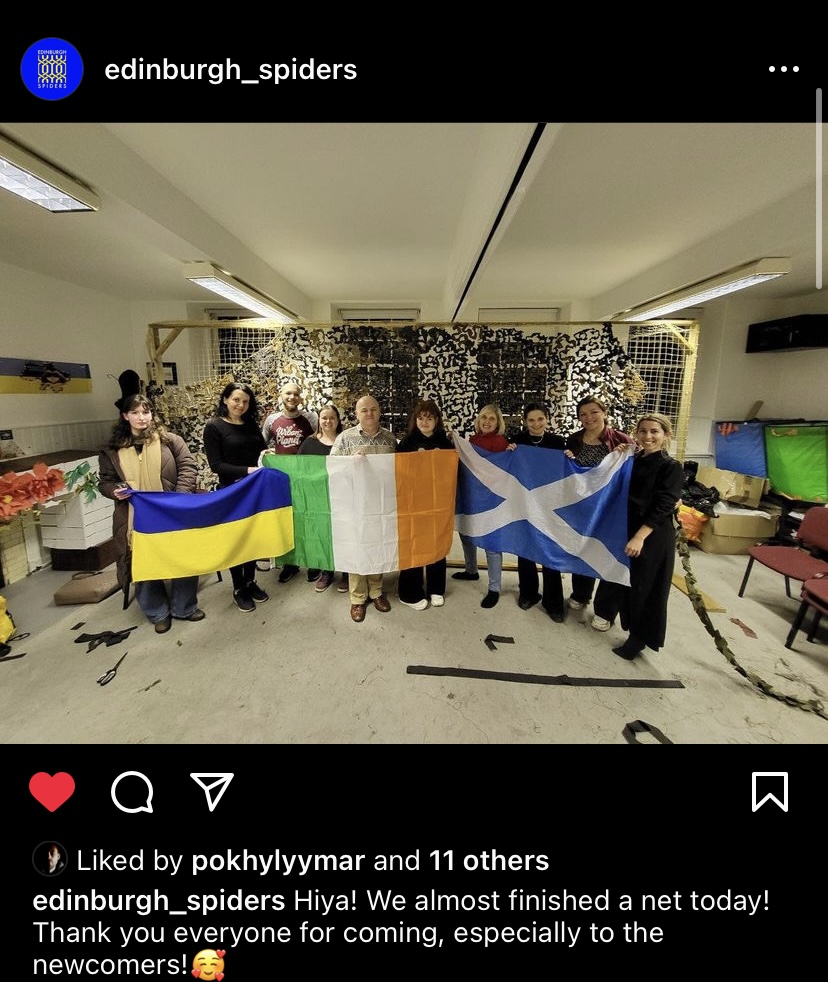
What started as a small opportunity to help Ukraine quickly grew into 4 locations with people regularly coming to help. At first, there was a Telegram chat with only 11 people, but soon word of mouth helped and more people joined, mentioning Hanna.
‘Less than half a year later there were more locations. There were so many people coming in to help, they started telling us we needed more locations. We opened three more locations when one woman decided to knit at home, so we also considered her one of our locations.
‘Already, in February 2023, we had two more locations and in July 2023 one more added up. And one woman Olena started making the nets at home in the autumn of 2023.’
Hanna ensures that everything produced reaches the frontline. She says some volunteers have connections with the military, and they pass over requests from a particular brigade.
‘For example, my daughter Sofia received a huge order from one of the soldiers she worked with at a table. He is a commander of a tank brigade. He ordered we make 30 or 40 nets in a month.
‘The big advantage is that the armed forces give us feedback. They tell us the colours they need, for instance, a winter one or maybe a dark one for spring.’
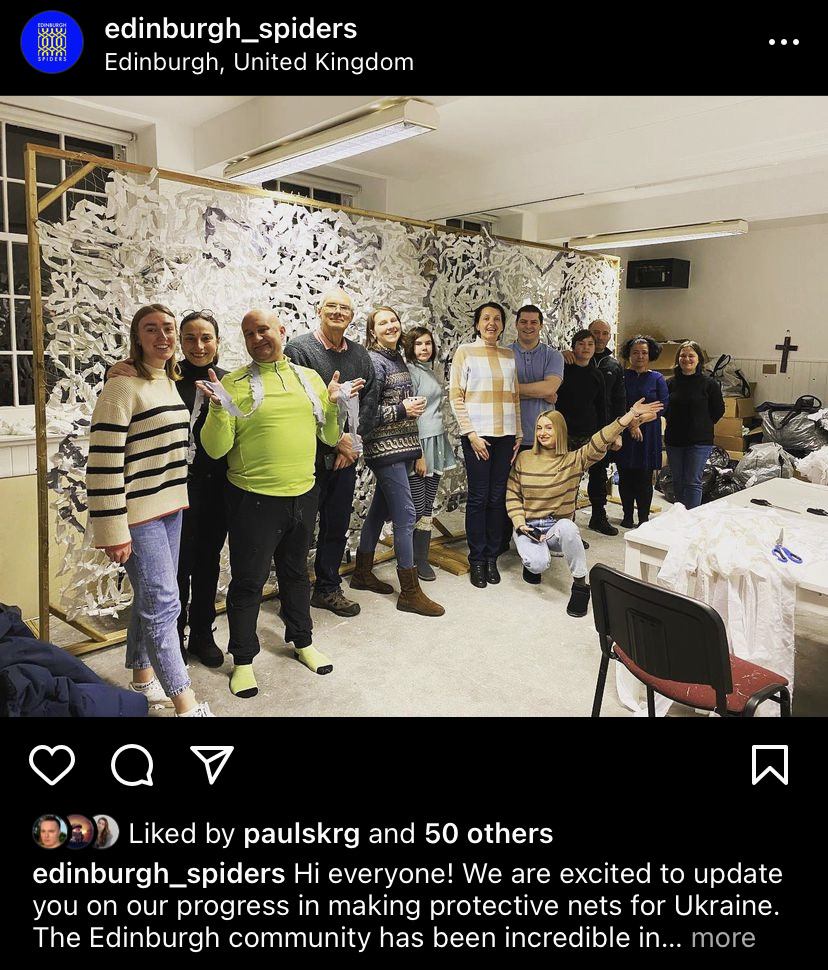
However, the challenge in this job lies in the constant need for supplies. Despite getting the fabrics for free from old sheets and clothes, Edinburgh spiders still have to get the carcass net, and they mostly buy these things by paying with the money from bake sales and their pocket. Although the nets are designed to protect soldiers and the equipment they use, many charities refuse to cooperate with them.
‘We tried to explain to them that our nets are not causing any damage. We didn’t hurt anyone physically and this is just the way to save lives and equipment. We didn’t get any response – just no, because people do not want to be involved in the war effort in any possible way.’
The only possible way Hanna sees for them to collect donations and maybe get support and funds from the government is to register officially as a charity and then fundraise money. Following this plan, Hanna hopes to mobilise efforts and establish sustainable work.
Contact
anyakonovalenko2002@gmail.com
 Anna Konovalenko